Triple-Slit Interference
Beyond Double-Slit: Three-Way Interference
Adding a third slit creates a richer interference pattern with subsidiary maxima between the principal peaks. This demonstrates how multiple coherent sources combine to create complex wave patterns.
The Physics
With three slits, the interference pattern becomes more structured:
- Principal maxima: Occur where all three waves constructively interfere
- Subsidiary maxima: Smaller peaks between principals where two waves reinforce
- Minima: More complex pattern of destructive interference
Intensity Pattern
For three equally-spaced slits, the intensity distribution follows: I(θ) = I₀ (sin(3φ/2)/sin(φ/2))²
Where φ = 2πd sin(θ)/λ is the phase difference between adjacent slits.
Pattern Characteristics
Triple-Slit vs Double-Slit Pattern:

Double-Slit:
████    ████    ████    ████    ████    ████
 (simple, evenly-spaced peaks)

Triple-Slit:
██████   ██   ██████   ██   ██████   ██   ██████
 (main)  (sub) (main)  (sub) (main)  (sub) (main)

 └─────────────────────────────────────────────┘
         More structure, sharper peaks
Key differences:
- Sharper principal maxima - peaks are narrower
- Subsidiary maxima - small peaks between main peaks
- Better resolution - useful for spectroscopy
The Simulation
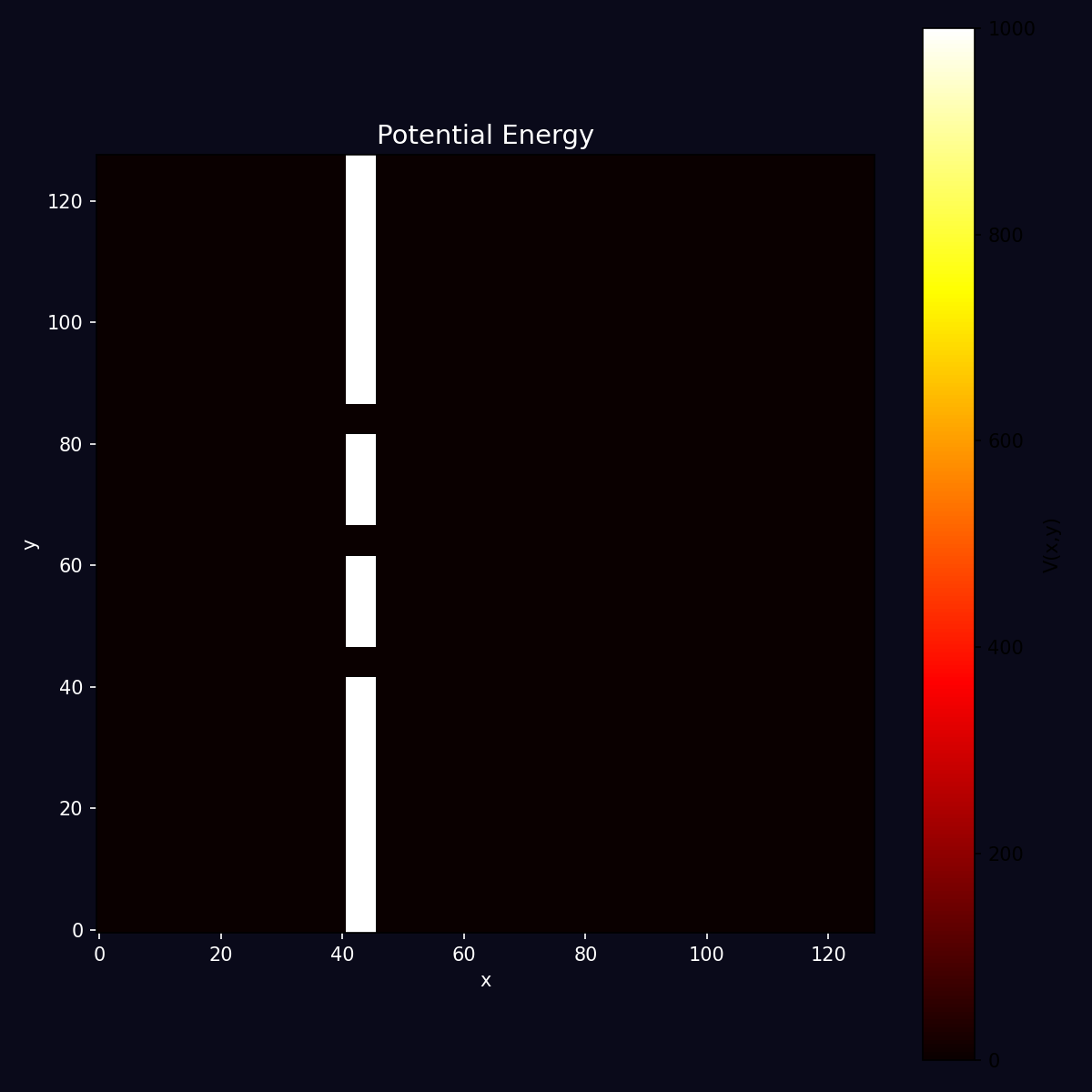
Grid: 512 × 512 points
Slit width: 5.0 units
Slit separation: 25.0 units
Number of slits: 3
Initial momentum: kx = 3.0
Animation
The video above shows the wavepacket evolution in real-time, revealing the complex three-way interference pattern.
Run It Yourself
claude -p "Simulate triple-slit interference: Create a barrier at x=85 with three slits \
  (separation=20, height=10), use an elliptical wavepacket with width=[15,50] \
  (vertical long axis), show potential overlay, add sensor line at x=220, \
  and save to /tmp/triple_slit.gif" --allowedTools "mcp__quantum-mcp__*"
From Slits to Gratings
The triple-slit experiment is a step toward the diffraction grating:
| N Slits | Pattern Characteristics |
|---|---|
| 1 | Broad central maximum, weak side lobes |
| 2 | Regular interference fringes |
| 3 | Sharper peaks with 1 subsidiary maximum |
| N | Very sharp peaks with N-2 subsidiary maxima |
| ∞ | Delta-function peaks (perfect diffraction grating) |
The Grating Equation
For N slits, principal maxima occur at: d sin(θ) = mλ (m = 0, ±1, ±2, ...)
And the peak width decreases as 1/N, making diffraction gratings excellent for spectroscopy.
Applications
- Spectroscopy: Gratings with thousands of lines separate wavelengths
- X-ray crystallography: Crystal lattices act as 3D gratings
- Holography: Interference patterns encode 3D information
- Quantum computing: Multi-path interference is fundamental
Side-by-Side Comparison
Related Demos
- Single-Slit Diffraction - Start with one slit
- Double-Slit Interference - The classic experiment
- Bragg Scattering - Interference from crystal lattices